
Hey guys,
It's been awhile since I've last posted. I was browsing around kickstarter.com and found this really cool vinyl toy. This toy encompasses more so for the sneaker design culture. I like that you can use this toy to create your unique sneaker designs. Enjoy and maybe you can contribute to this project!
for more info click here!
http://www.kickstarter.com/projects/1599006887/stance-diy-designer-art-toy?ref=live
Wednesday, March 16, 2011

Monday, February 7, 2011
Long time no post!
To any reader who has waited since August for a new post I'm sorry. Things have been beyond hectic in my life! But now I am happily married, back from China whipping our engineers into shape, and we're in a lull in our development cycle so I am back baby
Below is my newest tutorial for creating a turn around to show off your nice model using a combination of Hypershot and Photoshop. Enjoy and thank you all for sticking around I have some tutorial ideas up my sleeve and should be posting more frequently now.
Below is my newest tutorial for creating a turn around to show off your nice model using a combination of Hypershot and Photoshop. Enjoy and thank you all for sticking around I have some tutorial ideas up my sleeve and should be posting more frequently now.
sketchatoy seventeen from sketchatoy on Vimeo.
Also I have started posting in HD so that people can actually see the menu's I am going to. If you want to watch my new videos in HD please click here to watch it on vimeo.Wednesday, August 4, 2010
Gender and Toys
Here's an interesting article I found on new studies found children are born with gender preferences in toys. Studies were conducted on infants as early as 9 month olds.
Gender and Toys
Gender and Toys
Wednesday, July 28, 2010
Top 10 Toys of the summer
Toys are toys right? Check out the top ten toys of the summer for the ultra rick. These include a bmw mountain bike and a ferrari surfboard. The coolest one has to be the Scubacraft.
THE TOP 10 TOYS OF THE SUMMER
THE TOP 10 TOYS OF THE SUMMER
Tuesday, July 20, 2010
Thursday, July 15, 2010
Sketching with Painter
This is a short video that should get anyone who's interested at least starting to sketch and explore all the great features in Corel's Painter. I am using the default 2b pencil provided but the customization abilities in painter and the texture you can achieve is far superior to Photoshop or Sketchbook. (in my opinion of coarse)
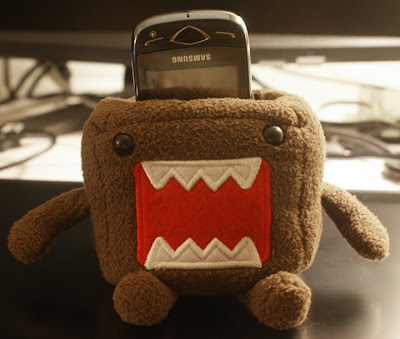
So have a look as I walk you all through the differences and similarities between Painter, Sketchbook, and Photoshop...then I draw my cell phone holder.
sketchatoy fifteen from sketchatoy on Vimeo.
So have a look as I walk you all through the differences and similarities between Painter, Sketchbook, and Photoshop...then I draw my cell phone holder.

Monday, July 12, 2010
Ducky Delingos
I stumbled upon these quirky designer bath toys from Gear For Imagination.
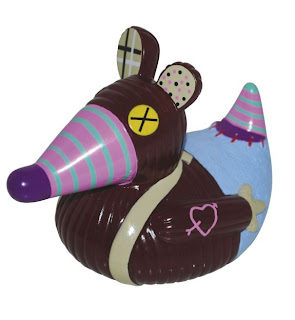

They were released on May 2010 and these toys feature four popular Delingos characters. Originally the characters were plush toys later transform into a bath toy without using the generic "duck" body. One of my favorites is the BigBos the Wolf.
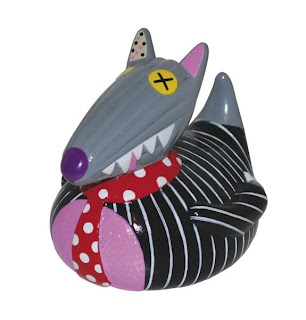
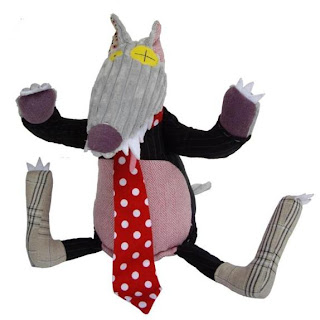
You can find the others here.


They were released on May 2010 and these toys feature four popular Delingos characters. Originally the characters were plush toys later transform into a bath toy without using the generic "duck" body. One of my favorites is the BigBos the Wolf.


You can find the others here.
Sunday, July 11, 2010
McCarty PhotoWorks
For all of you toy fans, check out Brian McCarty's new photography book. This toy photographer has 240 pages of toys representing there "true" environments.
Check it out HERE
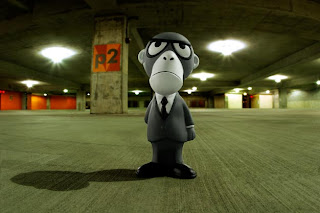
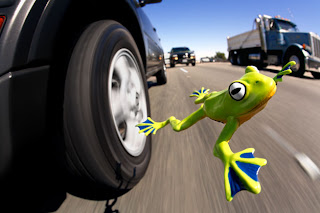

Check it out HERE


Monday, July 5, 2010
Design By Committee Continued....
I just finished reading the article posted by Garret and I thought I would add an additional link for those who are frustrated with his inevitable phenomenon.
Your design sucks! from Paul Boag on Vimeo.
I found this video awhile back and found it helpful and funny. Have a watch.
Why Design-By-Committee Should Die
Here is an article that I came across about how design has evolved into a "committee" decision process and the effects it has on the finished products. At the end of the article, the author briefly suggests some solutions. I disagree with they fact that we as designers have to "play the political dance of correctness and cooperation" to get a product to pass. Even in an industry such as toy design, where an outsider would think that the creative process must flourish to generate innovative concepts, we deal with with non design trained individuals in the company wanting to have to much control in the design process. It would be interesting to see how the rest of the readers deal with constantly having to defend their designs.
Below is the article.
Why Design-By-Committee Should Die
by: Speider Schneider
No matter where you go in the known universe, there is design-by-committee. It has become a pecking order of disaster for the society that used to pride itself on being a mover and shaker and that allowed its mavericks and dreamers to innovate their way to success. In a business climate fueled by fear and the “Peter Principle,” as it is today, a decision not made is a tragedy averted. So, decision by committee provides a safe and often anonymous process for finger-pointing down the line… inevitably leading to the creative, of course.
Below is the article.
Why Design-By-Committee Should Die
by: Speider Schneider
No matter where you go in the known universe, there is design-by-committee. It has become a pecking order of disaster for the society that used to pride itself on being a mover and shaker and that allowed its mavericks and dreamers to innovate their way to success. In a business climate fueled by fear and the “Peter Principle,” as it is today, a decision not made is a tragedy averted. So, decision by committee provides a safe and often anonymous process for finger-pointing down the line… inevitably leading to the creative, of course.
Why It Happens
Wikipedia describes it thus: The Peter Principle is the principle that “in a hierarchy every employee tends to rise to his level of incompetence.” It was formulated by Dr. Laurence J. Peter and Raymond Hull in their 1969 book The Peter Principle, a humorous treatise which also introduced the “salutary science of Hierarchiology”, “inadvertently founded” by Peter. It holds that in a hierarchy, members are promoted so long as they work competently.
Sooner or later they are promoted to a position at which they are no longer competent (their “level of incompetence”), and there they remain, being unable to earn further promotions. This principle can be modeled and has theoretical validity. Peter’s Corollary states that “in time, every post tends to be occupied by an employee who is incompetent to carry out his duties” and adds that “work is accomplished by those employees who have not yet reached their level of incompetence.
Whether on staff or freelance, we all walk into meetings prepared for our work to be torn to shreds. And it always is. The client sits there trying to explain to you how a logo the size of a small melon should sit on a 9×12-inch ad.
Our core competency is in creating something that is the perfect communication vehicle for the given message. But then subjectivity walks in the door, and the creative is left standing there, looking like an incompetent who needs a committee to complete their work.
Others Have Noticed Its Effects
Michael Arrington, founder and co-editor of TechCrunch, a blog covering Silicon Valley technology, and a widely respected and influential person on the Web, recently wrote:
There’s a saying I love: “a camel is a horse designed by committee.” A variation is “a Volvo is a Porsche designed by committee.” Some of the best product advice I’ve ever heard goes something like “damn what the users want, charge towards your dream.” All of these statements are, of course, saying the same thing. When there are too many cooks in the kitchen all you get is a mess. And when too many people have product input, you’ve got lots of features but no soul.
Through it all, I’ve heard some wondrous and magical statements come from the mouths of non-creatives as they “join in on the fun” of designing in these dreaded committee meetings.
My favorite exchange to date happened in a meeting that a secretary sat in to take notes but who eventually took over the conversation. I looked at her and then the art director, who sat sheepishly quiet (from too many emotional beatings, no doubt), and asked why a secretary would be allowed to give design feedback. She pulled herself up in her chair and said, “Well, you do want this to be the best product it can be?”
“The best it can be.” She was somehow convinced that her opinion overshadowed all others, including those of the art staff. In her mind, she was actually saving the design. Stories like this abound.
You’re Not The Only One
Wanting to feel I was not alone, I posed the question to the art directors among my umpteen connections on LinkedIn. The responses were varied, passionate and maddening at times. One of my favorite Los Angeles art directors gave me a list of her favorite sayings overheard in committee meetings:
My wife wants more circles.
My husband says it doesn’t hit him in the gut.
My kids say there are too many words.
My dog didn’t wag its tail.
The waiter said he’s seen something just like that in France.
I need more oopmh in it.
I’ll know it when I see it. So go back and make more.
I love what _____ did. Can you do the same, but with carrots?
What are you doing after work?
The next respondent to my question asked, “Did you forget to take your meds today?” Another chimed in, “I don’t want to give you any stories because I don’t want to cry!”
One creative director added these: “Why isn’t my logo bigger?”, “Why can’t we use all of this empty space over here?” and “It’s too promotional”. He adds: “ Anything from anyone who’s ever said, ‘I’m not creative, but…’ or ‘It needs more… something.’ And anything from anyone who ‘knows what they don’t want but has to actually see what they do want because they can’t describe/direct/vocalize it.”
Plenty of responses advised us to let go and just take the fee and do whatever the client or committee wants. This is a “service industry” after all. One graphic designer wrote:
One thing I try to do is understand why certain decisions have been made, and I do this by questioning the person doing the direction (this could be a colleague, sales person, client, etc.). If that person has legitimate reasons for asking for specific things, and they can back up that it will work, I’d like to know.
Another voice added, “He who pays calls the tune, even if they’re wrong, and even if they have poor taste. That is important to keep in mind.”
As much as I agree, there is still that voice inside me that screams bloody murder at the idiocracy of group decisions. Feeling the same way, an art director in Texas wrote, “The client may pay for the work, but who takes the blame when the client campaign fails miserably because the client did not listen to the advice of the designer?”
Who Should Ultimately Decide?
For better or worse, I agree with another passage in Mr. Arrington’s article:
Product should be a dictatorship, not consensus-driven. There are casualties, hurt feelings, angry users. But all of those things are necessary if you’re going to create something unique. The iPhone is clearly a vision of a single core team, or maybe even one man. It happened to be a good dream, and that device now dominates mobile culture. But it’s extremely unlikely Apple would have ever built it if they conducted lots of focus groups and customer outreach first. No keyboard? Please.
He also illustrates his point brutally with this hard fact:
Digg is sort of on the opposite end of the spectrum. The company has been standing still now for years as Facebook, Twitter and others have run laps around it. But the company is famous for listening to its hard core fanatical users.
My point is best made through the brilliant, funny, intelligent Better Off Ted. In one adventure, the corporation empowers everyone to make decisions about products in committee. See what happens to the simple product. The always classic “Process (aka Designing the Stop Sign)” is another frightening example soaked in truth.
Marketing aims to create consumer interest in goods and services based on the assumption that the target consumer is buying a lifestyle or habit, with some income, location and loyalty considerations thrown in. It draws from information about the target demographic; however, personal preferences about color, type size, logos and so on do not represent those of the target demographic. One person on a committee might be a target consumer, but certainly not the committee as a whole. Should people from disparate demographics second-guess the visual approach taken by the designer to the target consumer?
Mr. Arrington believes that the plan trumps all voices. His article ends with a very assertive video about winners and losers. Most creatives choose to let it wash over them and collect their pay check. I suppose I don’t agree because I haven’t seen many pay checks made out to “Dance, monkey, dance!”
What’s The Solution?
From all the responses and stories, it seems there are few ways to live with the design-by-committee lifestyle. Suggesting what a marketing plan or piece of copy is missing or implying that the secretary is unable to spell will only get you pegged as “difficult” and make you appear as though you “overstep boundaries.” Asking a non-creative who gives you excruciating input why they think you’re incapable of doing your job will brand you as “defensive” and “combative.” Give in, and you’ll earn descriptions like “flexible” and “easy to direct.”
The sensible answer is to listen, absorb, discuss, be able to defend any design decision with clarity and reason, know when to pick your battles and know when to let go.
A photographer I know once said, “I’ll give the model a big mole on her face, and the committee focuses on that and are usually satisfied with the momentous change of removing it and leave everything else as is.”
Whether you’re on staff or freelance, the political dance of correctness and cooperation brings a new story and new experience every day. And isn’t that one of the great things about this business… even if it goes around and around sometimes? You can just blame someone using the new buzzword, “Commidiot,” which is a committee member who has no idea what is going on in front of them but feels they have to say something of importance to justify their presence in the room.
Friday, July 2, 2010
LEGO Form Language
Designer Alex Marshall posted a rather interesting observation to his design blog; the subtle but jarring differences that makes or breaks a products identity. Please go to his blog and check out the post. The post is full of great design theory and is all about the iconic LEGO form language that's in most of our hearts!
He did find this great video about the manufacturing process of LEGO.
He did find this great video about the manufacturing process of LEGO.
Monday, June 28, 2010
Toy Design Thread and Toy Store Fun!
Stumbled across a discussion on Concept Art.org about toy design and all the "hats" a toy designer must wear. Have a read :)
Sing-A-Ma-Jigs from sketchatoy on Vimeo.
Also a few of the contributors and myself stopped by ToysRUs and had some fun with the new Sing-A-Ma-Jigs released this year by Mattel. I captured some of the play patterns with my cellphone.Monday, June 21, 2010
Scan Toys
As product designers we are always dealing with engineering and manufacturing, but these photographers are now looking at toys in a new way. Check out the visual artists Mónica Rojas and Hernán Eliaschev in the exhibition Scan Toys, which is now showing at the Centro Cultural Recoleta in Buenos Aires.

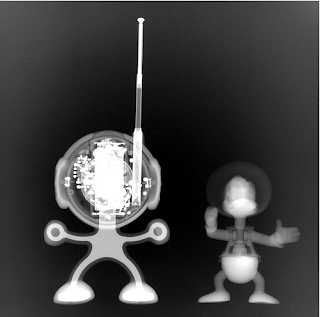
Check out more of there work Here on a Flickr photostream.


Check out more of there work Here on a Flickr photostream.
Wednesday, June 16, 2010
kidchuckle
Freelance illustrator,concept artist, and story-board artist Vince Chui has an amazing painting style in Photoshop. Here is a tutorial he did showing his sketching & rendering techniques...seeing someone with his talent gives me drive!!!
Mecha Santa from kidchuckle on Vimeo.
He has more tutorials on his youtube , or vimeo. Stop by his website, deviant, or coroflot, to check out more amazing work.Friday, June 11, 2010
Hero 108
Hey guys, I'll be helping out posting on this blog on my vinyl toys findings. For my first post, here's an awesome cartoon called Hero 108. This cartoon premiered on cartoon network on March 2010. It was produced by Gamania Digital Entertainment, Mike Young Productions, Moonscoop, and Cartoon Network Europe.
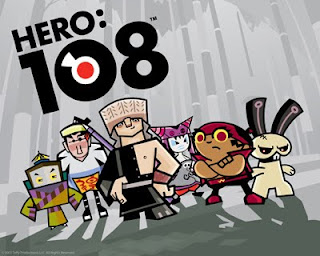
I like how the show is very stylized with sharp edgy characters. Each the characters also have a unique back story in which you can find here. Mainly I love that the style of shows reminds me so much of the vinyl toys scene. Luckily, I was able to find a few that was only distributed from last year's comic con in San Diego.
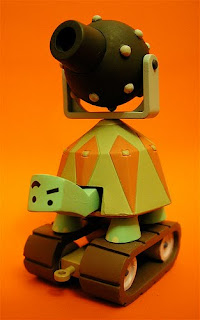
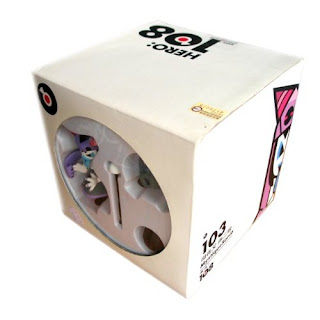
This is the turtle that the character rides on when they're on a mission to save their Commander Ape Trully. The next toy below is Mystique Sonia and the packaging they came in. She's been cursed with a spell when anyone who tell her he loves her three times in a row turns into a Yaksha. This creature sits on her head like a hat that also protects her from harm.

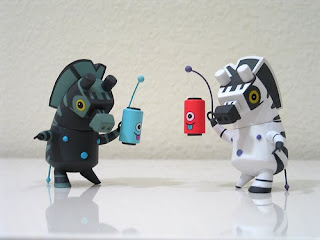
My favorite characters are the Zebra Brothers. I like their different color combination inspired from Ying Yang symbol. They're actually some of the villains of the show. The lanterns they're carrying have magical powers especially when there's a full moon.
Enjoy! Remember to check back soon!

I like how the show is very stylized with sharp edgy characters. Each the characters also have a unique back story in which you can find here. Mainly I love that the style of shows reminds me so much of the vinyl toys scene. Luckily, I was able to find a few that was only distributed from last year's comic con in San Diego.

This is the turtle that the character rides on when they're on a mission to save their Commander Ape Trully. The next toy below is Mystique Sonia and the packaging they came in. She's been cursed with a spell when anyone who tell her he loves her three times in a row turns into a Yaksha. This creature sits on her head like a hat that also protects her from harm.


My favorite characters are the Zebra Brothers. I like their different color combination inspired from Ying Yang symbol. They're actually some of the villains of the show. The lanterns they're carrying have magical powers especially when there's a full moon.

Enjoy! Remember to check back soon!
Thursday, June 10, 2010
Patch Together

Ever have that idea you know will make it big but you just don’t have the cash, know how, or resources to bring it to life? I know it’s difficult…luckily there is Patch Together. This was a cool website I found through an artist I follow on Deviant Art. Basically you upload illustrations, 3 views, CAD renderings…anything you want and then the members of the community vote if they would buy it as a toy, a t-shirt, or both. If you get enough votes then you can get your ideas manufactured! I think it’s pretty cool so check it out.
Blog Updates!
Time for me to give some updates. Because I have been struggling to keep the posts flowing, I have added 4 new authors to the blog! If you listened to the portfolio podcast then you have already met two of the new authors.
- MG is responsible for the awesome plush tutorial.
- Boxerinside is a da Vinci inspired gadget geek
- happyapathy is a vinyl toy junkie that has sent me many-a-posts
- GM teachers a sketching class while getting his masters,
I think they will add some well needed diversity to this blog.
If you have been following the blog since it's creation you know that I normally do a monthly feature. I am sorry but there will not be one for the month of June. I do however have several lined up that I have been meaning to e-mail. So never fear more professional knowledge will be coming!
- MG is responsible for the awesome plush tutorial.
- Boxerinside is a da Vinci inspired gadget geek
- happyapathy is a vinyl toy junkie that has sent me many-a-posts
- GM teachers a sketching class while getting his masters,
I think they will add some well needed diversity to this blog.
If you have been following the blog since it's creation you know that I normally do a monthly feature. I am sorry but there will not be one for the month of June. I do however have several lined up that I have been meaning to e-mail. So never fear more professional knowledge will be coming!
Photoshop Styles Tutorial
sketchatoy fourteen from sketchatoy on Vimeo.
Hey everyone this a new technique I have been using recently since things are very busy right now at work and I need to get lots of concepts out quickly while maintaining the quality expected...this is how I do it. From beginning to end this rendering probably took me all of 15min. You get something pretty good looking quickly using these styles, so enjoy!
Thursday, June 3, 2010
I'm not dead!
Hey everyone. Let me apologize cause it's been 3 days short of a month since my last post. I promise to make an effort to keep all of this going but things are getting truly chaotic at work and at home. But enough about that...a week or so ago a reader forwarded me this article...enjoy
Design critic Alexandra Lange goes shopping for the perfect kids toy--and finds so much design falls short.
Design critic Alexandra Lange goes shopping for the perfect kids toy--and finds so much design falls short.
 It was perhaps the fifth or sixth time I found myself, flat on the floor, arm extended, sweeping a broom under the couch to try to retrieve the quarter-size wheels of my son’s Automoblox Minis that I thought, “This is not a good design.”
Everything about them looked great. Automoblox share the traits of many toys sold at Giggle, the MoMA Design Store, and the overpriced kids boutique in your neighborhood: They are made of wood, the colors are bright and unisex, they use no batteries, they evoke the past, and they cost significantly more than the plastic, pink-or-blue, light-blinking, noise-making blobs sold at Toys R Us. These qualities explain why three different people decided Automoblox were the ideal gift for the offspring of an architect and a design critic.
And yet, my son seemed perplexed by how to play with them, beyond rolling them back and forth, something any die-cast drugstore school bus can do. Automoblox promises creativity: “With Automoblox, your child plays outside the box—and builds the design pictured in his or her mind.” First, I think they are starting the advertising clichés a little young. Second, those design options are severely limited. You can exchange a sporty rear end for a utilitarian one, a green transparent cab for a purple one, one set of colored tires for another. But whatever you do, you get another car.
It took my husband’s outside-the-box thinking to make the whole thing into a flatbed (it takes two axles and all the center sections). Then we had a pile of unusable spare parts, including those wheels, which seem designed to be lost (replacements are $10). The box promised interchangeability, but all the change was color, not function. Automoblox are really like dolls for (primarily, not to stereotype) boys. All you can do is change their outfits.
Despite appearances, Automoblox are a trophy toy: all looks, no lesson. And as I survey the field of design toys for kids, I see too many other wooden, bright, no-battery, retro, expensive items that seem like no fun. It’s ironic that these are all aimed at the design-loving parent, because, with their emphasis on looks and embedded modernism, they are teaching precisely the opposite of outside-the-box thinking.
I see my son gravitating toward two poles in toys, either the entirely abstract, like plain blocks or the very specific, like Matchbox cars or fake fruits or Fisher Price Little People (I bought him the 1974 airport on eBay--the toy I always wished I had). The plain blocks allow kids to make anything. The cars, fruits, or Little People help them pretend to be adults. The blocks are totally modern--Frank Lloyd Wright played with unpainted Froebel blocks, Maria Montessori advocated toys with only one or two qualities that change (like blocks that were all square, all one color, but graduated in size). The cars and people, not so much.
I asked Lisa Mahar, owner of educational design store Kid O (who produced the block sets above and below) if there was any theory behind my hypothesis, and she said there was, to a point. “Montessori theory does back this up. Fruit, animals, maps, anything natural is presented in its true form. Manmade items like cars, buildings aren't represented in these schools. At City & Country School kids create man-made things on their own with blocks, paper, or wood.”
So Automoblox would not be allowed in that classroom, but the principle still applies. What’s problematic about Automoblox is partly that kids can’t exercise their own vision--all the cars come out looking like Corvettes—but also they also can’t play garage, or airport, or museum. The cars do too little. Other equally cool-looking toys, including seemingly basic sets of blocks, are gussied up with too much conflicting information.
Take House Industries’ Alexander Girard alphabet blocks, for example. “For a child learning how to read or spell, the letters are too stylized. There is also no reason for the colors—i.e. vowels aren’t all one color,” Mahar says. They are another trophy, one that would look good piled artfully by an adult on the bookshelf. I suspect no child really wants to make the Eames House either, the theme of the latest (and sold out) set of House Industries blocks.
If you want something that looks more fun than a Froebel set, better to buy the translucent Magna-Tiles (pictured below), or for smaller kids, buy the stackable SoftBlocks.
At the Museum of Modern Art’s Shape Lab, many toys are homemade, like yoga blocks with magnets attached, which allow visitors to explore wall composition a la Donald Judd. They have also used Grimm’s wooden blocks (pictured below), which are vegetable dyed (since paint chips), and toys from Learning Materials Workshop. “Our focus is on the open-ended, to let visitors build on their experiences instead of the toy guiding what the experience should be,” says Elizabeth Margulies, Educator, MoMA School and Family Programs.
I am not willing to ban representations of the man-made from my toy drawers. For a city child, I believe trucks, buses, rollers, and excavators are part of their natural world, and sometimes the farm focus of children’s literature can seem obsessive and out-of-place. There are a number of specific, operable, not battery-powered vehicles that let kids be in charge of their world, if not make it from scratch. Some are, however, plastic.
In my house the unused Automoblox pieces get compacted in the Battat Garbage truck, a sturdy, not garish item that sells for less than $20, has an operable hatch, and even comes with two trash cans. There’s even an eco-version, a recycling truck made of recycled plastic by GreenToys (of course).
From the moment he ripped open the box on the Battat, not for one instant was my son confused about its highest and best use. So buy the trophy toys for yourself--and don’t overlook the plain little cubes in the corner next time you are searching for the perfect toddler gift.
Alexandra Lange is an architecture and design critic, journalist, and historian based in Brooklyn. Her work has appeared in The Architect's Newspaper, Design Observer, Icon, Metropolis, New York Magazine and The New York Times. She is co-author, with Jane Thompson, of Design Research: The Store That Brought Modern Living to American Homes (Chronicle, 2010
Subscribe to:
Posts (Atom)
